
Billing & trust
Track the work. Keep the books clear.
Review captured time, prepare itemized invoices and reconcile trust ledgers alongside the matter. Built-in safeguards support your process; your firm remains responsible for its accounting and professional obligations.
The hour gets captured while it happens.
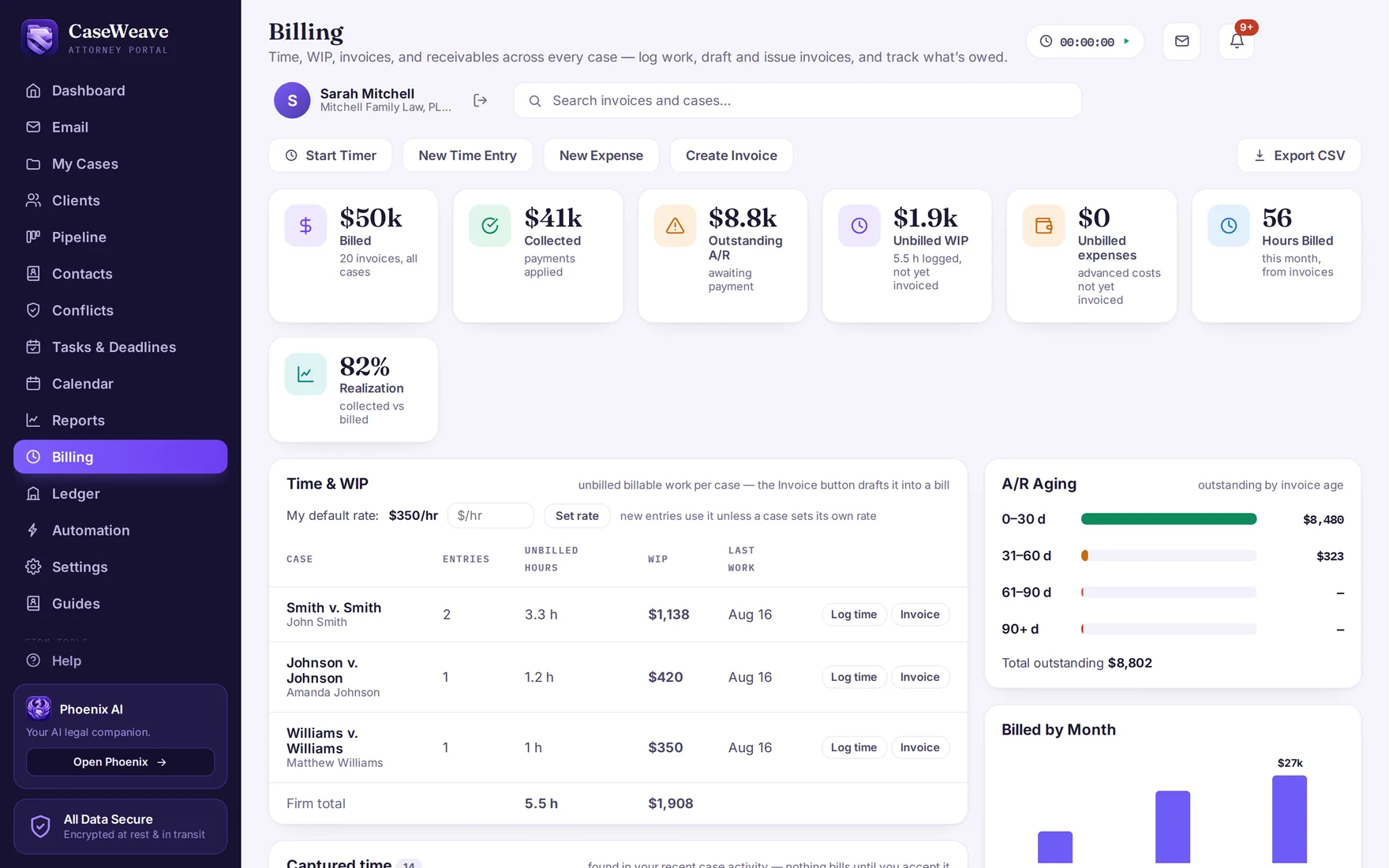
- Three ways inA timer that follows you across every page and survives a reload, manual entries, and passive capture — the platform notices billable work in the activity stream and drafts the entry for review.
- WIP to invoiceWork in progress rolls into draft invoices; you review, adjust and issue.
- LEDES 1998BInvoices export as PDF and LEDES 1998B, with honest expense-code mapping.
- The firm's numbersA/R aging, realization and billing reports — what a managing partner actually asks for.
Corrections stay in the history.
Per-matter trust ledgers with no edit and no delete — a mistake is corrected with an offsetting entry, the way a paper ledger does it. A matter's balance can never go negative, and balances are always derived from the entries rather than stored. Try it.
| Date | Matter | Description | Amount | Balance | Actions |
|---|---|---|---|---|---|
| 07/02 | Smith v. Smith | Retainer received | $7,500.00 | $7,500.00 | |
| 07/18 | Smith v. Smith | Fee transfer — Invoice 1042 | −$2,150.00 | $5,350.00 | |
| 08/01 | Smith v. Smith | Filing fee — district clerk | −$350.00 | $5,000.00 |
Three-way, with the bank statement in it.
The book balance, the client ledgers, and the bank statement — reconciled against each other, with bank CSV import to make the third leg real. Evergreen retainers replenish against invoices on the record, and close-out runs a trust guard: the ledger reconciles before the file closes.
Clients don't mind paying for good work. They mind not knowing what the work was — so every bill is itemized on their side too.
Transparency, both chairsSee the safeguards in practice.
Walk through time capture, invoice review and trust reconciliation using a demonstration matter.