
Documents & court output
From the record to the courtroom.
Draft beside the case record, collect signatures and prepare exhibit sets in the same workspace. Keep the source material close throughout the work.
The document never leaves the evidence it cites.
Quill is CaseWeave's own word processor — real .docx documents with tracked changes, comments, and redline compare, living inside the matter. Tick two documents and compare them side by side; open two versions of the same document and see exactly what moved.
Firm templates merge real case data into typeset documents — names, dates, the cast — and anything unresolved prints as a blank, never a guess.
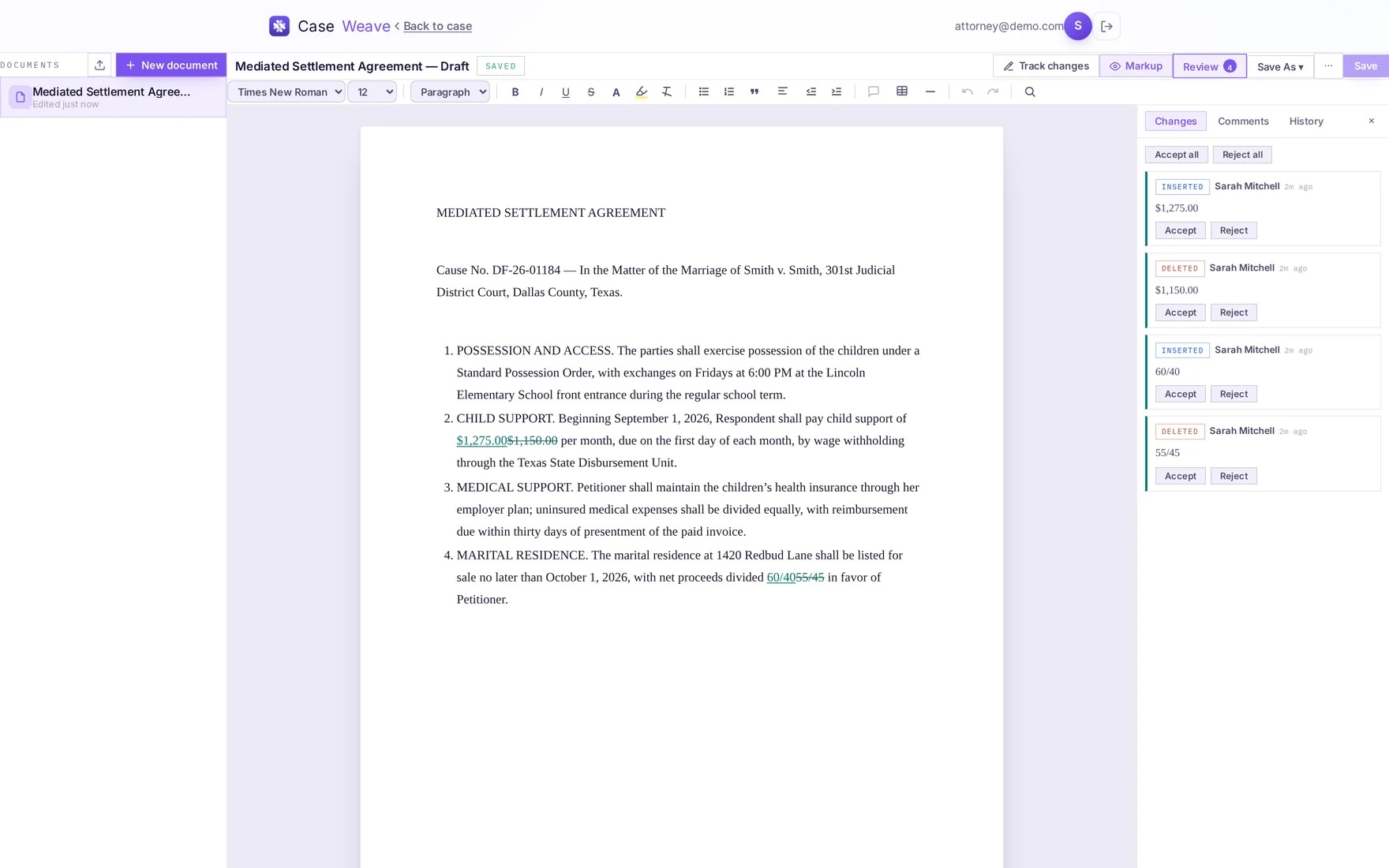
Exhibit sets with a traceable record.
One court-ready PDF: an index carrying the manifest hash, a separator page per exhibit printing that item's full SHA-256, and a continuous Bates stamp. Set the stamp the way your court likes it.
Live previewEvery exhibit page prints its item's full fingerprint beside the stamp.
Signed on the case, sealed in the record.
Send a document for signature and it's signed inside the platform — a typed-name acknowledgment in the ESIGN/UETA style, completed with a certificate that carries the document's hash and both parties' acts, written into the audit chain.
The signing certificate records the document fingerprint and signing activity for later verification.
- RequestedFrom the Documents surface, on any matter — the client signs in their app.
- CountersignedAttorney countersign lands on the same certificate — one document, both names.
- VerifiableThe certificate records the document's fingerprint at signing, so the signed thing is provably the signed thing.
- Printed outputEvery print from the platform carries a verification code, logged at generation — a printed page can be checked against the record later.